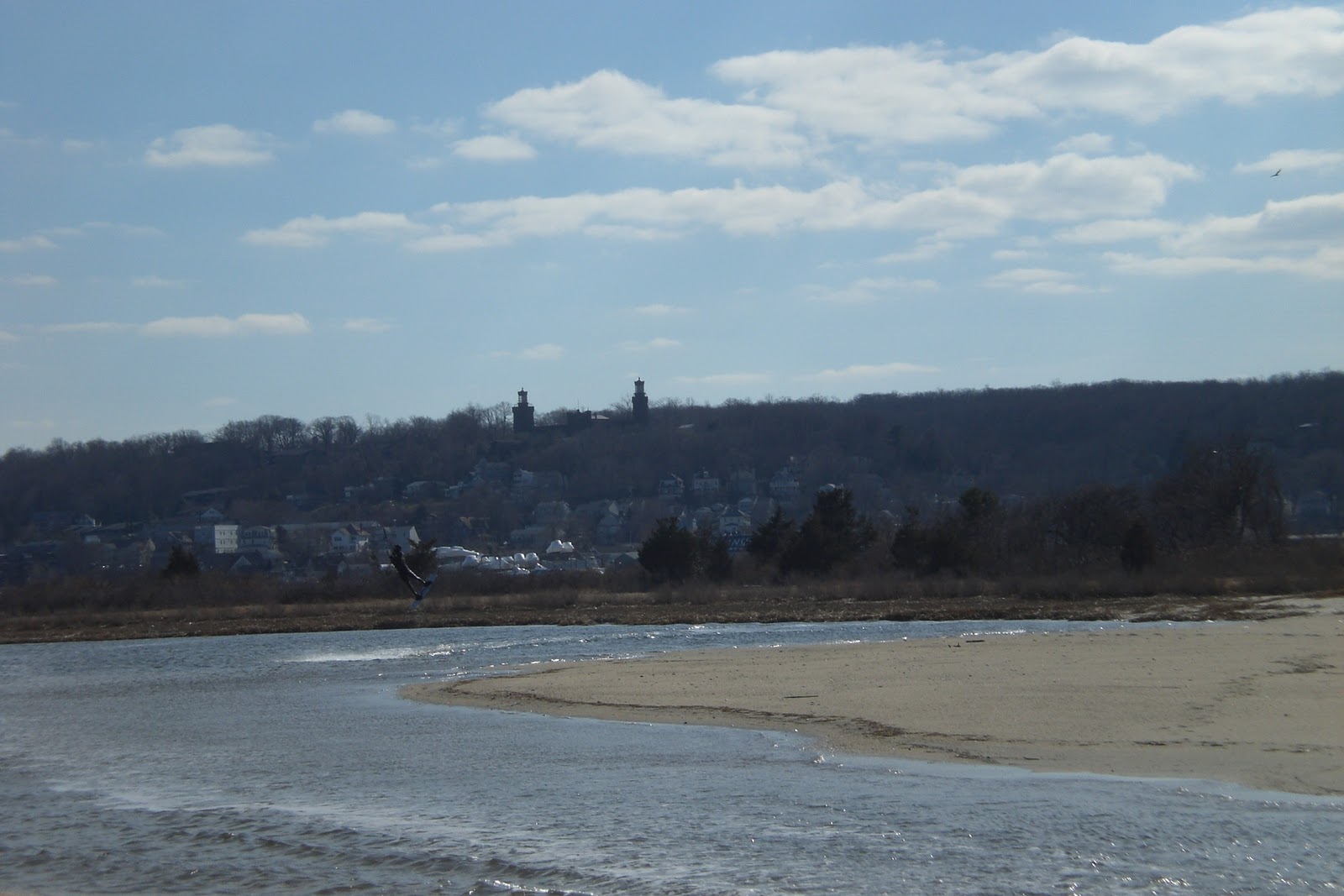
On Sunday March, 13th 2011, during my Spring Break Vacation, the conditions were perfect to go kiteboarding for the first time in 2011! The first day back on the water since December felt good. The air temperature was in the 50s, the water was in the 40s, and the wind was blowing average 25 mph gusting to 30 mph Northwest. The direction of the wind was preferred, Northwest when riding at the Hook. The gear I used for the whole three and a half hours I was out on the water for included my smaller kite a 2009 Best Kiteboarding Kahoona 7.5m, my smaller board a 130cm liquid force recoil, and a 5/4/3 NPX Assassin wetsuit with 5mm hyperflex gloves and booties and hood to keep me warm. With the wind coming from the Northwest direction that allows kiters to take full advantage of an area at Sandy Hook that is completely flat due to a sand bar that sits between it. The completely flat water while the wind is cranking allows for a faster and smoother ride where it is easier to practice new tricks. Below and to the right are pictures from the day.
Jumping in the flat water section at the Hook
Boosting a front roll! A front roll is when your body rotates
towards the front in the same direction your going while in the air.
Boosting air in the bay of Sandy Hook! In this picture
you can see how the bay can produce some swells,
when the wind is blowing over 25 mph.
My next post I think I will discuss more of the basic tricks in which may be performed while kiteboarding such as boosting big air, front rolls, back rolls, and more. Stay tuned until next blog post! Until then may the weather be warm and the wind crank.
Today would have been a perfect day to get back on the water with the air temperature in the 50s, water in the 40s, and wind averaging twenty miles per hour! Unfortunately for me I was unable to go kiting because the amount of work I have to get done by Wednesday that I won't have any time for in between today and then. Although in this blog post I am glad to announce that I was able to go snowboarding for the first time in my life on Thursday. I picked it up naturally and was able to ride intermediate difficulty slopes on the first day. Now that I have the ability to ride a snowboard down slopes I can't wait to advance and try snow kiting. Until next time enjoy this video of me kiteboarding Sandy Hook last summer.
A little more about the video: it was my first time using a GoPro HD HERO Camera - Wearable 1080p HD Video and Still Photo Camera. This little camera has the ability to shoot in 1080p HD! The video of me can be watched in HD on youtube if you click the on the video above and then switch the viewing mode. I would recommend the GoPro Hero HD camera to anyone looking for an extreme sports camera. Also In this clip at around 2:40 my main depower line snaps! Not a good thing as it is the main line in which most of the power from the kite is held. Luckily with the bar I was using it also had a separate red line depower line that I was able to utilize and come back to the shore line and land my kite.
Any day now it will be time to hit the water for me as I discussed in my last blog post. Picking the right day to get back on the water is very important, as I will discuss in this post the actual preparation of when to go kiteboarding. In order to kiteboard you need wind no matter what the temperature of the air and water is. In order to get an accurate forecast of the wind there are several different sources to use. The first source I use to get wind forecasts is http://www.ikitesurf.com/, for a annual subscription of around $100, this site offers current and past wind conditions and computer / human reviewed wind forecasts worldwide, where ever they have an installed sensor. Lucky for NJ kiteboarders there is a sensor installed right at Sandy Hook. There are free wind weather services too such as: http://www.windguru.cz/int/, http://www.noaa.gov/, and even http://www.weather.com. Although the wind reports from weather.com aren't very detailed the general weather forecast is great. Every kiteboarding location has a certain wind direction in which it is the safest to ride in. In the case of Sandy Hook Northwest wind is usually the best case and wind from the southwest is the opposite. A cool website that tells you kiteboarding locations and what the best wind direction for that location is http://www.kitebeaches.com/. When kiteboarding the ideal wind direction is usually a wind that is parallel to the shore line called a side shore wind. Off shore wind, when the wind is blowing away from the beach is avoided and very dangerous unless a power boat is spotting. It sounds like a lot of watching and waiting for the forecast to be right but once you get the chance to hit the water everything up to that moment is forgotten and truly worth the effort it took.
March 6th, 2010 Cleaning off my boards after
the first session back in the water!
Thanks to the snow for holding my
boards up while I could hose them off.
Since my last blog post I didn't get a snowboard or even a chance to try snow kiting, however I did get to enjoy the 60+ temperature days here in New Jersey! Since it is warming up it is almost time to get back on the water so snow kiting for me will have to wait till maybe next season. The Sandy Hook Bay water temperature today reported 40.5 degrees Fahrenheit. Sounds cold but with the right gear perfect time to get on the water. Cold water gear such as a drysuit or wetsuit make it possible to ride in the coldest conditions. The coldest condition I have kiteboarded in was probably in the Decemeber of 2009 at the hook. The water temperature was in between 32 - 35 degrees Fahrenheit, while the air temperature was in between 40 - 50 degrees minus the wind chill with the wind blowing 20 - 30 miles per hour. With the water temperature so cold I wore a 5/4/3mm thick wetsuit with a wetsuit hood, gloves, and booties. The combination of gear keeps your body so warm that it is amazing just how cold of conditions it is possible to ride in.
The picture to the right above was taken after my first session back in the water last year, March 6th 2010. This year looks like I may be able to beat that day if the weather stays warm like the last couple of days! Within the next few weeks I should be able to get in my first 2011 kiteboarding session!
This week's blog post will teach the basics of kiteboarding. First off lets talk about the gear. An average kiteboarding setup will cost in between $1,000 - $2,000. A small price to pay considering the gear will last with several years of use and no expensive fuel is needed. Below is a list of the gear needed to get started.
- Board w/ pad and straps ($200 - $500)
- Kite w/ Bar & Lines ($800 - $2,000)
- Harness ($100 - $200)
- Pump (usually included with purchase of a kite)
To the right above is a picture of all the gear. (Resting on the board is the harness) Once you have all the gear or even before, it is essential to take lessons which on average run about $80 an hour. The only places in New Jersey to take lessons are greenhatkiteboarding and islandsurf-sail both located by the Barnegat Bay.
The boards and kites needed for kiteboarding come in all different sizes to accommodate for riders of different weights and different wind conditions. Riders will often have a quiver of kites and boards to ride in any condition. The best condition or ideal winds to ride in are steady 18-20 mph winds. I have kiteboarded in winds from 6 - 12 mph to winds 35 mph gusting to 45 mph!
The kite pictured on the left is perhaps the most important piece of equipment needed and I recommend to always buy new or at least within a year or two old. The technology of the kites and control systems have evolved so much that any kite three or more years old is very dangerous for beginners. A brief description of the way the kite functions follows. A rider takes out the kite of a bag and pumps air into it with a foot pump. The air fills usually one large bladder and four to five other bladders, which give the kite its shape and makes it possible to relaunch the kite when it lands or crashes on the water. The kite is attached by four to five flying lines that lead down to a control bar. When the control bar is pushed away from the rider, the two back lines are given slack and the power of the kite is null (de-powered). When the control bar is pulled in toward the rider, the back lines become tight and the kite gains power. Below is a video of me a couple years ago just cruising in the Sandy Hook Bay. This video I hope will give you a sense of how riding and just cruising takes place.
Until next post, watch Catchin' Air before the Super Bowl at noon on HD Theater!